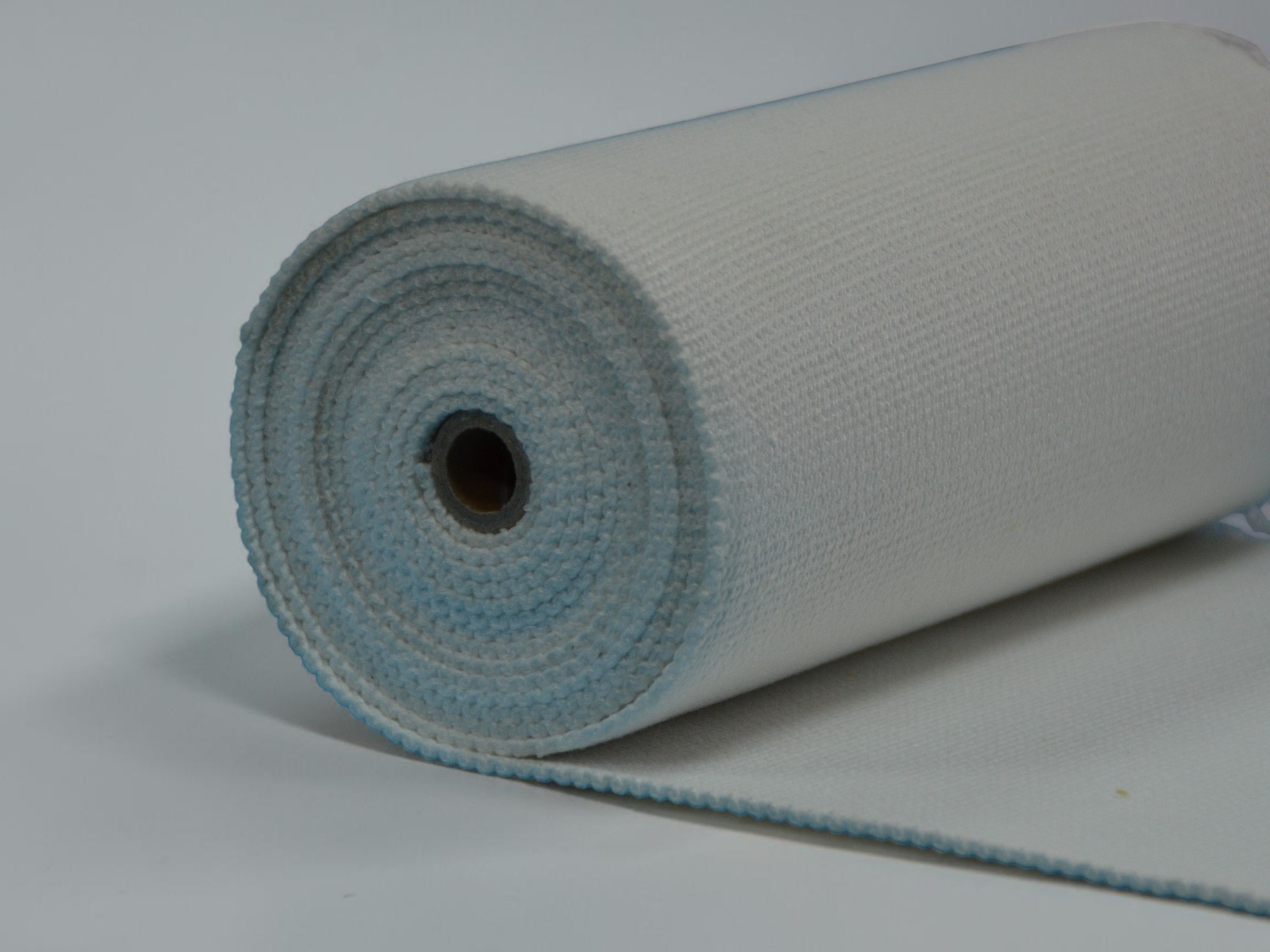
Choosing airslide fabric (also called air slide cloth or aeration fabric) is a specification exercise, not a brand exercise. Get the four numbers below right and the fabric will fluidize the powder evenly; get one wrong and you see weak discharge, uneven air distribution or early wear.
1. Air permeability and air resistance
Air resistance must match the blower and the powder behaviour. Shengquan fabric is grouped into Type A 350 mmWG, Type B 500 mmWG and Type C 800 mmWG classes (measured at 400 m³/m²/h). Heavier or more compacted powders usually need a higher resistance class to fluidize properly; too much air creates local channeling.
2. Thickness and width
Standard thickness runs from 4 to 8 mm. Thinner fabric fits tighter installations; thicker fabric adds durability under heavy loads. Width matters for seam reduction: our maximum width is 2500 mm, which lets most air slide troughs and silo sectors be covered in one piece.
3. Weight and tensile strength
Fabric weight (from roughly 3600 to 7800 g/m² across our range) correlates with strength and durability. Warp and weft tensile strength determine how the fabric behaves during installation and under sustained air pressure, so match them to the installation method and operating load.
4. Operating temperature
Material selection is driven by temperature. Polyester covers -60 to 150°C (short-term 180°C); aramid 1313 reaches 220°C and aramid 1414 up to 250°C; basalt handles up to 600°C. If your process runs hot, move up the material ladder rather than over-specifying width.
The fastest way to confirm a replacement is to send the old sample or a drawing. We match the closest weave, thickness, width and converted shape, and confirm the specification before quoting.